Claude Skills for Scientists: Accelerating Research Workflows with AI
How the K-Dense-AI claude-scientific-skills collection is transforming research — from analyzing 450 wearable sensor files in 35 minutes to automating literature reviews and hypothesis generation.
A researcher at a university biomedical lab recently shared a striking data point: using the exploratory-data-analysis skill from K-Dense-AI's claude-scientific-skills collection, she analyzed 450 wearable sensor files that would have taken her team three weeks to process manually — in 35 minutes.
That number, 35 minutes versus three weeks, captures something important about what AI-assisted research can look like when the right tools meet the right domain expertise.
The Problem with AI in Research Workflows
Researchers have been using AI tools for years, but the adoption pattern is frustratingly fragmented. A biologist might use a specialized tool for literature review, a different platform for statistical analysis, a third for writing, and keep Claude or GPT open in a browser tab for "everything else." Context doesn't transfer between these tools. Domain knowledge doesn't accumulate. Every session starts from scratch.
Claude Code changes this by providing a persistent, programmable environment. But the raw capability of Claude Code — while enormous — isn't immediately useful to a marine biologist who needs to run Granger causality tests on ocean temperature data. The skill layer closes that gap.
The claude-scientific-skills Collection
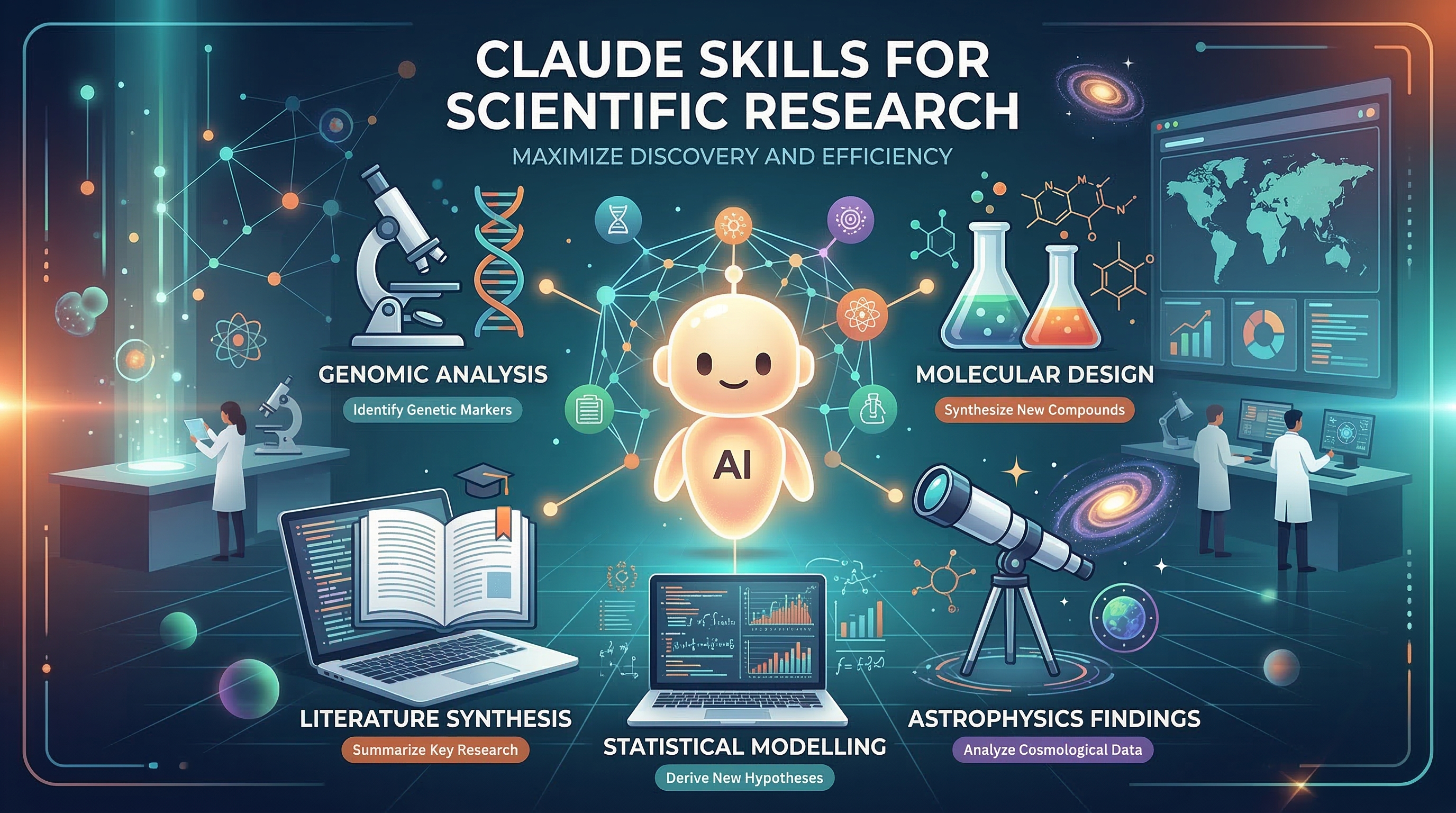
K-Dense-AI's claude-scientific-skills collection (14,000+ stars on GitHub) provides a library of research-domain skills that teach Claude the vocabulary, methods, and conventions of scientific work. The collection currently includes 174 skills across eight research domains.
The architecture follows the Claude Skills progressive disclosure pattern: each skill's metadata tells Claude when it's relevant (a few tokens), and the full instructions load only when needed. A session working on statistical analysis loads the stats skills; one focused on literature review loads the citation management skills. Your context stays clean regardless of how many skills are installed.
Exploratory Data Analysis
The exploratory-data-analysis (EDA) skill is the most broadly applicable in the collection. It teaches Claude to approach a new dataset with the discipline of a trained data scientist:
- Structural audit: dimensions, data types, missing values, format inconsistencies
- Univariate analysis: distributions, outliers, central tendency for each variable
- Bivariate analysis: correlation matrices, scatter plots, cross-tabulations
- Domain-specific checks: based on detected data type (sensor data triggers temporal consistency checks; genomic data triggers base pair validation)
- Findings report: plain-language summary of key observations and anomalies
The 35-minute wearable sensor analysis that caught our attention used this skill. The researcher had 450 CSV files from accelerometers worn by study participants. Without the skill, processing would have required custom Python scripts, manual quality checking, and hours of exploratory plotting. With the skill, she described her research question ("I need to identify activity patterns and flag data quality issues before statistical analysis") and Claude built a complete analysis pipeline.
The skill also explicitly separates description from inference — a critical discipline in exploratory work that's easy to violate when you're excited about apparent patterns.
Citation Management
The citation-management skill solves a problem that every researcher knows intimately: the literature review.
It teaches Claude to:
- Search semantic scholar and PubMed APIs for relevant papers
- Extract key claims, methods, and findings in structured format
- Identify citation networks (who cites whom, foundational papers vs. recent applications)
- Flag contradictory findings across papers
- Generate formatted citations in APA, MLA, Chicago, and discipline-specific formats
- Maintain a structured research bibliography that accumulates across sessions
The cross-session persistence is particularly valuable. A researcher building a literature review over several weeks can use the skill to maintain a living document of their sources, with Claude adding new papers, updating relevance scores as the research focus sharpens, and flagging when new papers cite existing sources.
Hypothesis Generation
The most ambitious skill in the collection is hypothesis-generation. It implements a structured ideation protocol that moves from observation to testable prediction:
- Observation formalization: convert informal observations into precise statements
- Mechanistic exploration: what processes could produce this observation?
- Constraint identification: what do we know that would rule out certain explanations?
- Hypothesis ranking: which explanations are most testable, most novel, most significant?
- Experimental design sketch: for top hypotheses, what would a test look like?
The skill explicitly discourages hypothesis generation that's either too narrow (testing what you already expect to confirm) or too broad (unfalsifiable in principle). It draws on established methodologies from philosophy of science — Popper's falsifiability criterion, Lakatos's research programme structure — without burdening the researcher with the meta-level theory.
Researchers who've used this skill report that the most valuable output isn't usually the top-ranked hypothesis but the constraint identification step. "It surfaced two constraints I hadn't explicitly considered," one computational biologist noted, "and ruling those out changed which direction we pursued next."
Statistical Analysis Workflow
The statistical-analysis skill provides a structured approach to quantitative analysis that prevents common errors:
- Assumption checking before test selection: normality, homoscedasticity, independence
- Multiple comparison correction: automatic Bonferroni/FDR adjustment when running multiple tests
- Effect size reporting: alongside p-values, because statistical significance ≠ practical significance
- Confidence interval calculation: for all estimates
- Visualization: publication-quality plots in matplotlib/ggplot with appropriate uncertainty representation
The skill is deliberately opinionated about best practices. It will push back if you ask for a test that violates its assumptions without acknowledgment. This pushback is documented in the skill's design as intentional: it's better to be slowed down by a methodological challenge than to publish results based on an invalid test.
Domain-Specific Skills
Beyond the general-purpose skills, the collection includes domain-specific variants:
genomic-data-analysis: FASTQ/BAM file handling, variant calling pipelines, pathway analysis, integration with bioinformatics tools (BWA, GATK, DESeq2)
environmental-science-eda: Spatial data handling, temporal autocorrelation, climate model output interpretation, GIS integration
clinical-trial-analysis: ITT/per-protocol analysis, CONSORT reporting, survival analysis, regulatory submission formatting
materials-science-characterization: XRD/XPS data interpretation, SEM image analysis, structural prediction integration
Each domain skill is built on the general EDA framework but adds discipline-specific vocabulary, checks, and conventions.
A Day in the Lab with Claude Skills
To make this concrete, here's how a graduate student in computational neuroscience might use the collection over a research day:
Morning (new dataset, EDA):
"I have EEG data from 30 subjects, 64 channels, resting state and task conditions.
Let's run EDA to check data quality and characterize the signal properties."
Claude loads exploratory-data-analysis, runs the structural audit (flagging 3 subjects with artifact contamination), generates channel-by-condition spectral profiles, and produces a quality report with flagged files removed.
Midday (literature context):
"I'm seeing unexpected alpha suppression in the visual cortex during the working memory task.
What does the recent literature say about this?"
Claude loads citation-management, searches for papers on alpha oscillations + working memory, identifies a 2024 meta-analysis that addresses exactly this pattern, and adds 12 relevant papers to the session bibliography with key claims extracted.
Afternoon (hypothesis, statistical test):
"Based on what we've found and the literature, I think the alpha suppression is related to
attention deployment rather than memory load. How would we test this?"
Claude loads hypothesis-generation, formalizes the hypothesis, identifies the key contrast needed (load vs. attention conditions), proposes an ANOVA design, then loads statistical-analysis to run the analysis and produce the results table.
The entire day's work — EDA, literature review, hypothesis formalization, statistical analysis — happens in a single persistent session with accumulated context. The researcher doesn't re-explain their dataset to each tool.
Getting Started with Scientific Skills
The claude-scientific-skills collection is available on Claude Skills Hub. Here's the recommended path for a new user:
Installation
# Download from Claude Skills Hub
# Install to global skills directory
cp -r claude-scientific-skills ~/.claude/skills/
First Steps
Start with the EDA skill on a dataset you know well. This calibrates your expectations — you'll see how Claude interprets your data type, which assumptions it makes, and where it needs more context from you.
Then try citation-management with a topic you're currently reviewing. The key discipline here is letting Claude's structured format shape how you record sources, rather than trying to fit its output to your existing workflow.
Domain Calibration
The collection's skills are general by default. They become more powerful when you calibrate them to your domain at the start of a session:
"I'm working on marine sediment geochemistry. My data includes δ18O and δ13C isotope
ratios from foraminifera. Let's start EDA with that context."
This framing ensures Claude applies domain-appropriate interpretations rather than generic statistical norms.
The Bigger Picture
The claude-scientific-skills collection represents a new category: domain expertise encoded as transferable AI workflows. The 14,000 stars it's accumulated suggest this category is resonating with the research community.
What's striking about the collection's design is its conservatism. These skills don't try to replace scientific judgment. They codify the methodological discipline that good scientists apply anyway — assumption checking, effect size reporting, structured hypothesis generation — and make it consistently available regardless of how pressed for time a researcher is.
The 35-minute wearable sensor analysis wasn't a shortcut. It was the same analysis the researcher would have done in three weeks, done with AI assistance that handled the implementation while she focused on interpretation.
That's the promise of domain-specific Claude Skills: not faster shortcuts, but the same rigor, available faster.
The claude-scientific-skills collection by K-Dense-AI is available on Claude Skills Hub. Source on GitHub.