The Best Claude Skills From Top Tech Companies: OpenAI, Vercel, HuggingFace, and Microsoft
Discover the best Claude Skills created by top tech companies including OpenAI, Vercel, HuggingFace, and Microsoft. These official company skills bring production-grade workflows to Claude Code.
When Rivals Agree on the Tool, That Says Something
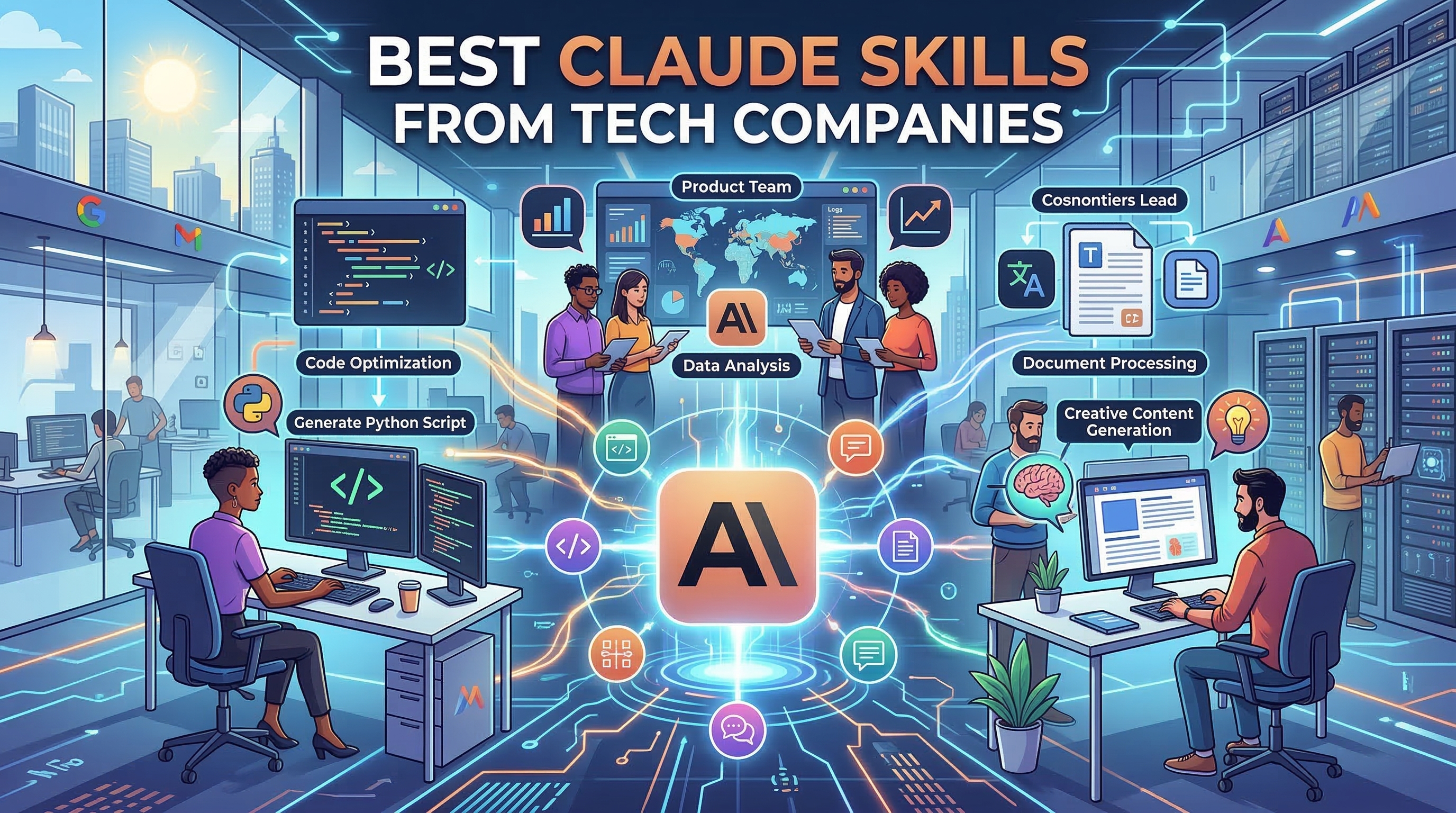
When OpenAI publishes a collection of Claude Skills — skills designed to extend Anthropic's own Claude Code — it signals something important: Claude Skills have become a standard, not a bet. The same pattern holds for Vercel Labs, HuggingFace, and Microsoft. These are companies with engineering cultures known for high standards and strong opinions. They all chose to invest in Claude Skills.
This guide covers the best Claude Skills from each of these four organizations. Every skill here was authored by engineers who work inside these products daily, which means the workflows encoded are tested, realistic, and production-grade.

OpenAI Skills — The Gift From the Competition
Repository: openai/skills — 13,695 stars, MIT license
The most surprising entry on this list is also one of the most useful. OpenAI's skills repository contains over 65 curated skills spanning deployment, security, data science, browser automation, and project management. The collection lives under a .curated/ directory, signaling that these skills represent the team's deliberate picks rather than an unfiltered dump.
Figma Integration
The Figma skill connects Claude Code to Figma's MCP server, enabling direct design-to-code workflows. Rather than copying component specs by hand, Claude can read Figma frames, extract style tokens, and generate component scaffolding that matches your existing codebase patterns. Design handoff becomes a conversation.
Playwright Browser Automation
OpenAI's Playwright skill turns Claude into a capable E2E test author. Provide user flows or acceptance criteria in plain English and Claude produces well-structured Playwright tests with proper locator strategies, assertion logic, and retry configuration. OpenAI's version includes best practices drawn from operating large-scale test suites.
Security Best Practices and Threat Modeling
Two security skills stand out from this collection. The security-best-practices skill gives Claude a framework for reviewing code against OWASP Top 10 and common vulnerability classes. The security-threat-model skill goes further, teaching Claude to reason through threat surfaces systematically — assets, entry points, trust boundaries, and mitigations — using structured templates that produce auditable output.
Deployment Skills: Vercel, Netlify, and Render
OpenAI ships deployment skills for the three major hosting platforms: vercel-deploy, netlify-deploy, and render-deploy. Each skill encodes the configuration details, CLI flags, environment variable patterns, and rollback procedures specific to that platform, so Claude handles the operational details rather than requiring you to consult documentation.
Jupyter Notebook
The jupyter-notebook skill is the clearest signal that OpenAI's engineers use Claude Code for data science work. It teaches Claude how to structure notebooks with clear cell organization, reproducible environment setup, inline documentation, and clean output management. For data teams, this skill closes the gap between exploration and production-ready analysis.
Linear Project Management
The linear skill brings project management context directly into Claude Code. Claude can query issues, update statuses, create new tickets, and link code changes to the right work items — all from within the development environment. For teams on Linear, this skill makes the connection between planning and shipping frictionless.
Vercel Labs Skills — The Best Frontend Workflow Skills
Repository: vercel-labs/agent-skills — 22,620 stars
Vercel Labs occupies a unique position: they build the infrastructure that most modern React and Next.js applications run on, and their skills reflect that deep operational knowledge. This is the smallest focused collection on the list, but the quality per skill is exceptional.
Deploy to Vercel
The deploy-to-vercel skill is the standout. Rather than a single vercel CLI invocation, this skill encodes Vercel's full deployment decision tree: preview vs. production deployments, environment variable scoping, edge function configuration, custom domain wiring, and rollback procedures. Claude reasons through the right deployment method based on your project type and target environment.
React Best Practices
The react-best-practices skill is one of the most content-dense skills available — 58 specific rules covering React performance, component design, state management, and testing. These are not generic reminders. They reflect Vercel's experience running some of the highest-traffic Next.js applications in production. When Claude reviews or writes React code with this skill active, the output reflects current best practices rather than year-old tutorials.
Composition Patterns
The composition-patterns skill teaches Claude the modern React component composition model: compound components, render props, slot patterns, and the distinction between presentational and container layers. For teams refactoring legacy class-based code or building design systems, this skill provides a consistent architectural vocabulary.
HuggingFace Skills — The AI and ML Researcher's Toolkit
Repository: huggingface/skills — 8,691 stars, Apache-2.0 license
HuggingFace is the infrastructure layer for the open-source AI community. Their Claude Skills reflect the workflows of researchers who train, evaluate, and deploy models daily. These skills are essential for anyone doing serious ML work with Claude Code.
HuggingFace Hub MCP
The hf-mcp skill connects Claude Code to HuggingFace's Model Context Protocol server. This gives Claude direct access to the Hub API — browsing model cards, checking license terms, fetching model configurations, and inspecting dataset structures without leaving your development session. For researchers who regularly discover and evaluate new models, this is a workflow-defining skill.
LLM Fine-Tuning: SFT, DPO, and GRPO
The hugging-face-model-trainer skill is arguably the most technically sophisticated skill on this entire list. It gives Claude a structured understanding of three modern fine-tuning paradigms: Supervised Fine-Tuning (SFT), Direct Preference Optimization (DPO), and Group Relative Policy Optimization (GRPO). Claude can scaffold training scripts, configure trl and transformers parameters correctly, and explain the tradeoffs between methods based on your dataset and compute budget.
For teams doing custom model training, this skill compresses months of practitioner knowledge into an accessible interface.
Dataset Management
The hugging-face-datasets skill teaches Claude the HuggingFace datasets library at depth: loading from Hub, applying transformations, filtering, splitting, pushing to Hub, and working with large datasets via streaming. Data preparation is consistently the most time-consuming phase of ML projects, and this skill makes Claude a capable collaborator for that work.
GPU Cloud Computing with HuggingFace Jobs
The hugging-face-jobs skill covers HuggingFace's GPU cloud compute platform. Claude learns how to configure training jobs, estimate costs, monitor run status, retrieve logs, and handle common failure modes. For researchers without on-premise GPU clusters, this skill makes cloud compute feel local.
Microsoft Azure Skills — Enterprise SDK Integration
Repository: microsoft/agent-skills — 1,669 stars, MIT license
Microsoft's contribution to the Claude Skills ecosystem is narrowly focused but deeply valuable: a complete set of Azure SDK skills for TypeScript. Each skill encodes not just API usage but the correct authentication patterns, error handling conventions, and production configuration for that Azure service.
Azure Cosmos DB
The azure-cosmos-ts skill gives Claude fluent knowledge of the Cosmos DB SDK — container management, query construction, partition key strategy, change feed patterns, and throughput provisioning. Enterprise applications with globally distributed data requirements will find this skill significantly reduces time spent reading SDK documentation.
Azure Identity
The azure-identity-ts skill is the foundational skill for secure Azure development. It teaches Claude the correct credential chain for different environments: DefaultAzureCredential for local development, managed identity for production deployments, service principal configuration for CI/CD. Getting authentication wrong in Azure is a common source of production incidents, and this skill encodes the correct patterns.
Azure Storage Blob
The azure-storage-blob-ts skill covers the full blob storage API: uploading, downloading, listing, generating SAS tokens, configuring access tiers, and handling large file transfers with block blob APIs. For applications that handle file uploads or media assets on Azure, this skill is immediately practical.
Azure AI Projects and Search
Two skills cover Microsoft's AI service integrations. The azure-ai-projects-ts skill provides patterns for integrating with Azure OpenAI, prompt flow, and AI Studio deployments. The azure-search-documents-ts skill covers Azure Cognitive Search — index creation, semantic search configuration, faceted filtering, and hybrid search combining keyword and vector results.
Azure Monitor and OpenTelemetry
The azure-monitor-opentelemetry-ts skill rounds out Microsoft's collection with observability patterns. Claude learns how to instrument Node.js applications with OpenTelemetry, configure Azure Monitor exporters, set up distributed tracing across service boundaries, and create custom metrics and dashboards. For production deployments, this skill makes the difference between flying blind and having complete observability.
How to Install These Skills
All skills from these repositories are available through Claude Skills Hub. The installation process is the same for every skill:
- Find the skill on Claude Skills Hub and click Download
- Place the downloaded
.mdfile in your project's.claude/skills/directory - Restart Claude Code or start a new session
- Claude will automatically load the skill and its capabilities will be available
For bulk installation from a specific company's repository, you can clone the source repository directly and copy the skills files you want into your project directory. Skills are plain Markdown files with no installation script or dependency manager.
# Example: install all Microsoft Azure skills
git clone https://github.com/microsoft/agent-skills
cp agent-skills/*.md your-project/.claude/skills/
Skills are additive and composable. Running the azure-identity-ts skill alongside azure-storage-blob-ts gives Claude the combined knowledge to write authenticated storage operations correctly on the first attempt.
What Makes Company-Published Skills Different
Community skills vary widely in quality. Skills from established engineering organizations have distinct advantages:
Tested against real production systems. OpenAI's deployment skills encode the edge cases their own teams hit. HuggingFace's training skills reflect workflows researchers actually use. Microsoft's SDK skills match the patterns their Azure SDK team recommends.
Maintained with the product. When Vercel changes a deployment API or Microsoft updates an SDK, the skills tend to be updated alongside the product. This is less reliable with individual contributor skills.
Conservative and opinionated. Company skills tend to be more conservative than community experiments. They favor proven patterns over clever shortcuts. For production engineering teams, that conservatism is an asset.
The skills in this guide are a strong foundation for any serious Claude Code workflow. They represent years of combined engineering experience from some of the most demanding technical environments in the industry, encoded into a format that Claude Code can use immediately.
Browse all skills to explore additional options across every category, or visit the guide section for more recommendations.